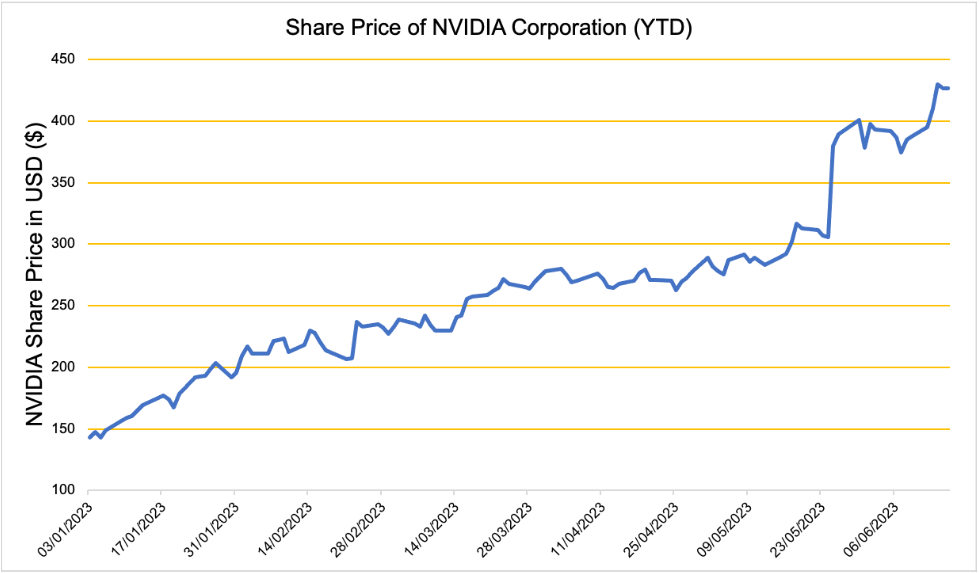
NVIDIA Corporation (NVDA) has been the subject of a meteoric rise in valuation, especially in recent months. Since January 2023, its stock price has risen 198.32% from a price of $143.15 on 03/01 to $426.92 on 16/06. “The rise and the rise” of NVIDIA, as major publications are labelling it, has been the result of a fortuitous crossover between two of the world’s most in demand technologies, semiconductors, and artificial intelligence.
Figure A
Source: William John Analytics, Yahoo Finance
Semiconductors scientifically refer to a crucial class of materials that exhibit certain electrical conductivity properties. Specifically, when manipulated they can control the flow of an electrical current, which enables the manufacture of transistors, diodes and circuits that are used in turn to create microprocessors, memory chips, sensors and solar cells, for example.
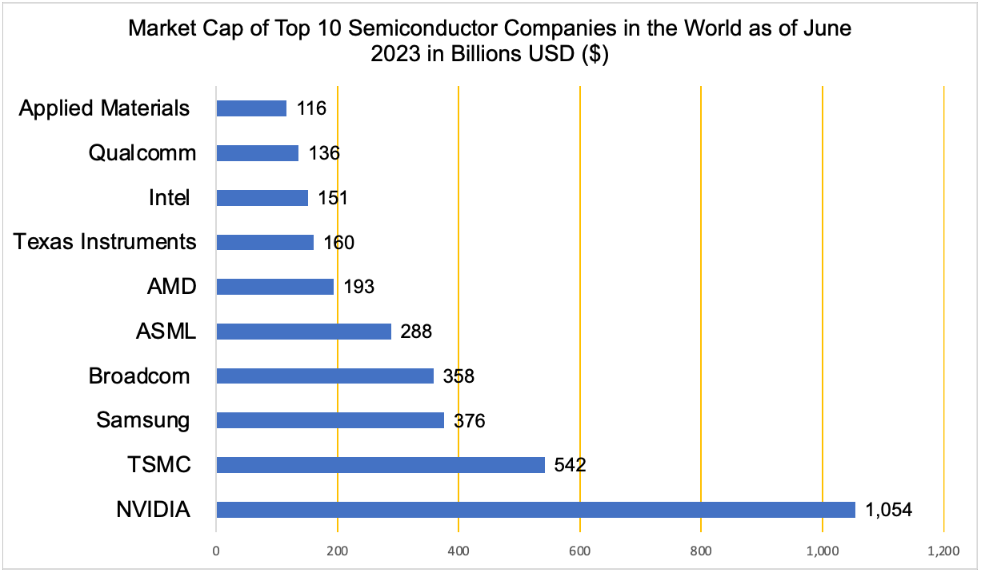
Because of their essential role in modern day electronics, they form a critical part in various industries, including telecommunications, consumer electronics, energy, automotives, just to name a few. Moreover, the largest semiconductor manufacturers in the world all have a dominant market position in some respect. For example, Texas Instruments specialises in producing semiconductors for analogue and embedded processing applications whilst Nvidia controls over 80% of the world’s supply of high-performance GPUs. Qualcomm focuses on wireless communication technology and Samsung is one of the largest, most dominant forces in the consumer electronics market. The Taiwan Semiconductor Manufacturing Company has the largest semiconductor foundry in the world. Looking at the top 10 semiconductor companies by market cap:
Figure B
Source: William John Analytics, Bloomberg
All top 10 companies are $100-billion-dollar companies, with an average annual revenue of approximately $37 billion, and the semiconductor industry is one of the most lucrative industries in the global economy for a reason – some even rationalise the U.S.’s hard-line foreign policy on Taiwan due to the West’s reliance on the largest semiconductor foundry in the world being established there.
Despite this information, semiconductors alone cannot explain what has driven Nvidia to a valuation almost double that of its second placed competitor, Taiwan Semiconductors. Instead, this may be down to the rise of a complementary industry and underlying technology which Nvidia specialises in, Artificial Intelligence.
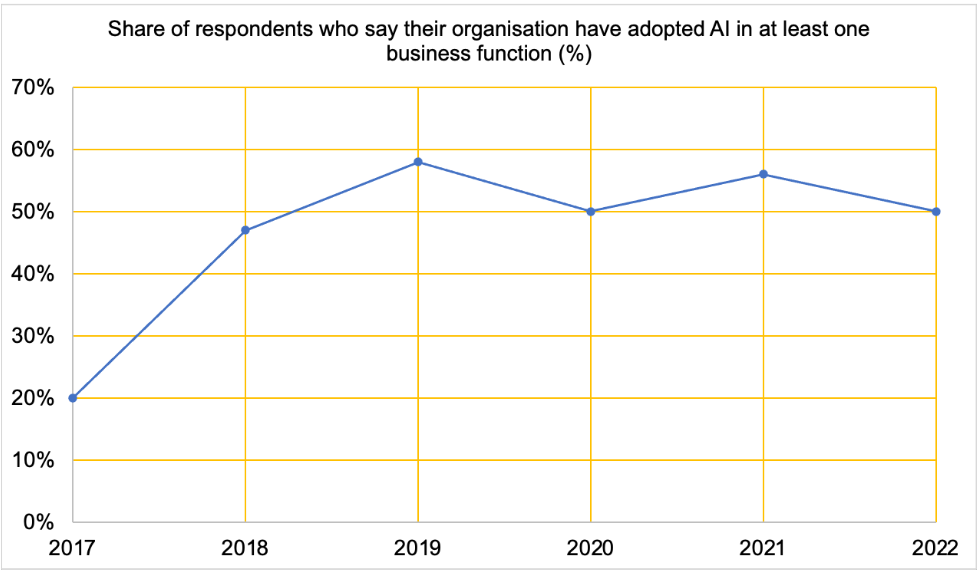
Artificial Intelligence (AI) has become widely popularised with advances in generative AI, that is, AI which attempts to generate new or original language based on patterns and examples from datasets its trained on, as opposed to being predictive or using classification. According to a recent study by McKinsey & Co., a survey of businesses global show that up to half of global companies have adopted AI in at least one function of their business:
Figure C
Source: William John Analytics, McKinsey & Co.
Specifically, these functions were identified as:
Figure D

Source: William John Analytics, McKinsey & Co.
With the artificial intelligence industry anticipated to grow by a compound annual growth rate (CAGR) of 37.3% until 2030 and the value of the industry already indicatively demonstrated by the rise of the notable generative pre-trained transformer Chat GPT, it is clear that the drive behind Nvidia’s explosion in value is its specialisation in semiconductors for the AI market.
The company’s dominance stems from a combination of factors that contribute to its competitive advantage in this rapidly expanding sector.
Nvidia’s GPUs have emerged as the go-to solution for AI training and inference, owing to their parallel processing capabilities. With the ability to handle the complex computations required for deep learning algorithms, Nvidia GPUs have become the industry standard. Furthermore, Nvidia goes beyond hardware solutions, offering comprehensive software frameworks and libraries tailored specifically for AI development. Its CUDA parallel computing platform, coupled with libraries like cuDNN and TensorRT, provides developers with powerful tools to harness the full potential of Nvidia GPUs for AI tasks. This integrated approach of combining hardware and software gives Nvidia a competitive edge in the AI semiconductor market, attracting developers and enterprises seeking efficient and optimized solutions.
Nvidia’s GPUs have witnessed broad adoption in AI research, development, and deployment across a range of industries. The healthcare, finance, autonomous vehicles, and robotics sectors, among others, have embraced Nvidia’s GPUs for their AI workloads. Additionally, Nvidia has fostered strategic partnerships with major technology companies, cloud service providers, and startups in the AI space. Collaborations with industry giants like Microsoft, Amazon Web Services (AWS), and Google Cloud have resulted in joint product offerings and integrated solutions that further strengthen Nvidia’s position as a leading provider of AI hardware. This extensive ecosystem not only enhances Nvidia’s market reach but also reinforces its brand reputation as a reliable and trusted provider of AI semiconductor solutions.
Nvidia’s commitment to ongoing research and development is another crucial factor in its favor. The company continuously pushes the boundaries of AI and GPU technologies, investing in the development of new GPU architectures and advancements in AI-specific features. By staying at the forefront of technological innovation, Nvidia ensures that it remains well-positioned to meet the evolving demands of the AI semiconductor market.
As a result of its market leadership, comprehensive software offerings, strategic partnerships, ongoing innovation, and brand reputation, Nvidia is poised to capitalize on the growing adoption of AI across industries. With its strong position in the AI semiconductor market, the company is primed to enjoy substantial gains and maintain its competitive edge in the years to come, and this is why Nvidia is a trillion dollar company.
Any opinions expressed in this document are those of William John and are provided for information only. E&OE