On 22nd November 2023, Chancellor of the Exchequer Jeremy Hunt outlined the Treasury’s Autumn Statement to Parliament and the Public focusing on five key focus areas: reducing debt; cutting tax and rewarding hard work; backing British business; building domestic and sustainable energy; and delivering world-class education.
Assessing the first focus area, reducing debt, the Government stated it is on track to meet its debt and borrowing fiscal rules and that, relative to the Spring Statement in March, it had much greater headroom. Furthermore, addressing its forecast for underlying debt, U.K national debt as a % proportion of GDP is forecasted to increase to 92.8% in 2028-2029 from 86.1% in 2022- 2023, but fall from a high of 93.2% in 2026-2027:
Figure A
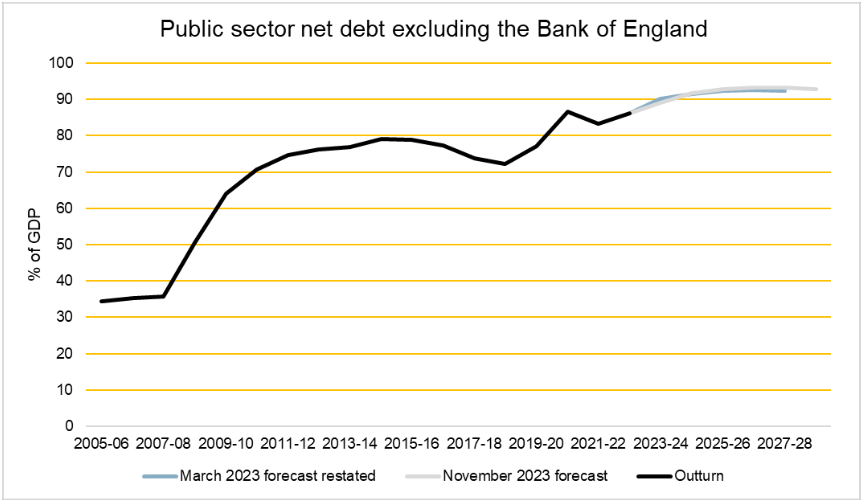
Source: William John Analytics, Office for Budget Responsibility
However, in order to reduce net public debt, the government has had to take a string of measures to reduce the cost of public services, consolidating departmental budgets and pushing for greater efficiency as noted in its “Public Sector Productivity Programme”.
Cutting costs on public services and major infrastructure programmes, such as HS2, may yield some economic gains in the long run. However, they have proved politically unpopular and the significance of this is likely to be felt at the next general election.
Addressing the second focus area, the Government is looking to “cut tax and reward hard work”. Acknowledging the difficult of fiscally coping with the Covid-19 pandemic and the invasion of Ukraine which drove energy prices skyrocketing, the Government seems optimistic about growth opportunities in the U.K. “With inflation falling”, the Government will cut taxes for over 29 million people. Specifically, the main rate of Class 1 employee National Insurance will be cut from 12% to 10% from 6th January 2024. This means that the average worker on £35,400 will receive a tax cut in 2024-2025 of over £450.
This will provide a combined rate of income tax and NICs for an employee paying the basic rate of tax of 30%, the lowest since the 1980s.
Moreover, the Government is going to cut taxes for those who are registered as self-employed. The benefits of these policy adjustments are expected to benefits around 2 million self- employed individuals and result in the average self employed person on £28,200 saving £350 in 2024-2025. Whilst these tax policies are hallmark decisions of Conservatism, in contrast the Government has introduced additional positive measures to support people out-of-work and those on low-paid incomes.
The Government has pledged to increase the National Living Wage (U.K. minimum wage) by 9.8% to £11.44 whilst lowering the threshold to earn this wage from 23 years old to 21 years old. This represents an increase of over £1,800 to the annual earnings of a full-time employee and is expected to benefit over 2.7 million low paid workers. This is alongside measures to improve access to work for people who are economically inactive due to long-term sickness and disability, extending and expanding the “Restart” programme for those who are long-term unemployed and triple locking and uprating the basic State pension in line with average earnings growth of 8.5%.
Overall, this second focus area is a strong set of traditional Conservative tax policies and more Centrist support for those most vulnerable economically to encourage growth and “reward hard work”. They come at time where these measures may be critical to reverse declining real incomes:
Figure B
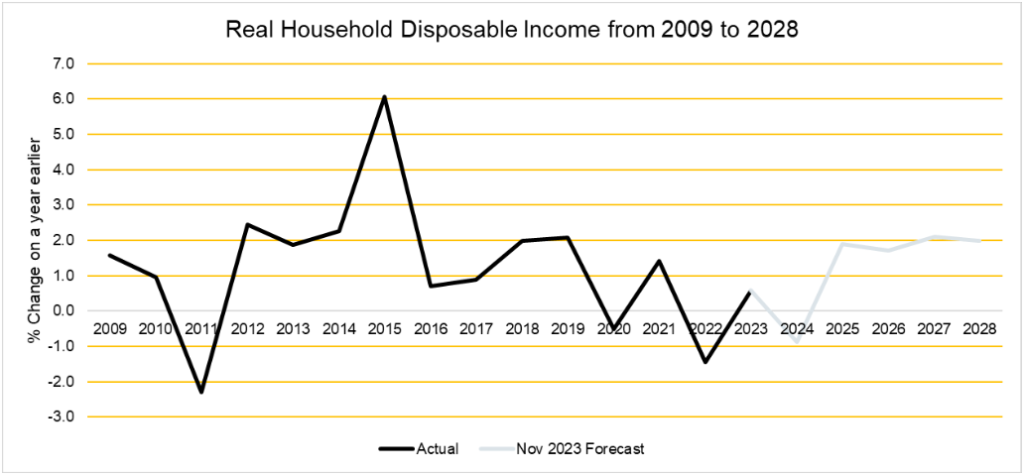
Source: William John Analytics, Office for Budget Responsibility
Assessing the third focus area, “Backing British Business”, the Government claims the best way to grow the economy is not through higher borrowing but by creating the conditions for the private sector to remove barriers to investment and cutting taxes for businesses. They note that business investment has been lower than other leading advanced economies at 9.5% of nominal GDP over the last 10 years compared to 11.2% on average in France, Germany and the US. To fix this, the Government is doubling down on its “Super Deduction” corporation tax
policy. With the policy already the lowest amongst its G7 counterparts, the Government has also decided to make permanent measures for business to write off the full cost of qualifying plant and machinery investment and has introduced a business rates supports package worth £4.3 billion over the next five years to support small businesses and the high street. The Government fresh approach to “full expensing” makes the U.K.s capital allowances amongst the most generous in the world worth over £10 billion per year, of which the OBR expects the U.K. to unlock an addition £14 billion of investment over the forecast period.
Addressing the fourth focus area, “Building Domestic and Sustainable Energy”, the Government is looking at reforming the planning system to speed up approvals and setting out a plan to reduce the time it takes for new projects to connect to the grid.
Interestingly, the Government dedicated no chapter to the final focus area, “delivering a World Class Education” – however, the Government has already announced the implementation of a “skills reform programme”, increased budget for schools and apprenticeships and bursaries for teacher training.
Overall, the Autumn Statement seems to hold within it robust policies that appear well-funded and carefully analysed alongside the OBR (Office for Budget Responsibility). Given the cost-of- living crisis, falling real household incomes, further cuts to underfunded public services, will the focus on the future of Britain’s education and investment create enough growth in enough time to win the Conservatives an election with the general public growing weary of a Conservative Government which has been in power since 2010 … that remains to be seen.
However, all the aforementioned policies seem sensible and thought through for the long term of the country – which will doubt accelerate investment in the U.K, boost productivity and positively impact British markets.
Any opinions expressed in this document are those of William John and are provided for information only. E&OE